


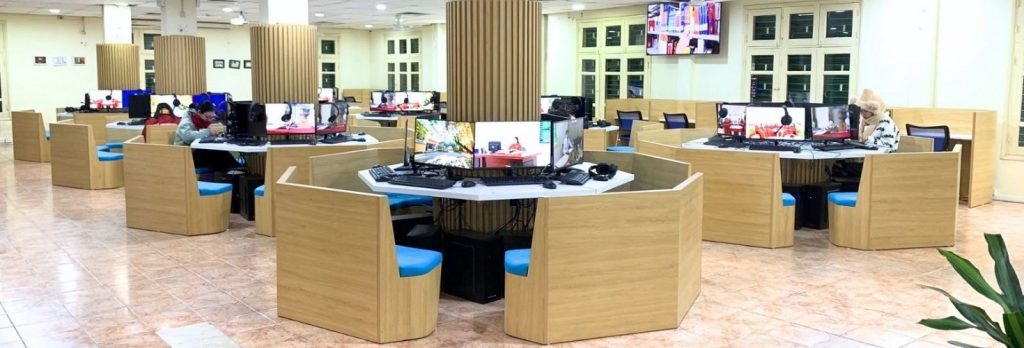
Hanoi University Library was established shortly after Hanoi University was established. In the early period, the Library operated under the model of a working group serving the school’s documents, under the Department of Education. The Library’s activities were limited, the documents were mainly textbooks, specialized reference books such as: Russian and languages of Eastern European countries (Polish, Czech, Bulgarian, etc.). The main source of documents was sponsored books, aided by countries in the socialist system.
In 1967, in response to the requirements of expanding the scale of training and improving the quality of teaching, Hanoi University of Foreign Languages opened a number of majors such as: English, French. Along with the establishment of a number of faculties and departments, the number of documents increased significantly. By 1984, the school’s leaders decided to separate the document group from the Department of Education into an independent unit called: “Hanoi University of Foreign Languages Library”. After separating into an independent unit, in 1994, the Library built a new 2-storey building, with an increasing number of documents, partly meeting the document needs for the school’s training work. During its operation, the Center has continuously upgraded its technical facilities, innovated and improved its organization and operations, and gradually applied information technology to professional activities.
In 2000, along with the innovation of programs and teaching methods, and the improvement of the quality of foreign language training in the education sector, the School Board decided to merge the Library with the Information Department and change its name to “Hanoi University of Foreign Languages Library – Information Center”. The Library implemented an open modernization project, using World Bank loans – World Bank levels A and B to invest in upgrading the technical facilities of the headquarters and equipment.
On December 5, 2003, the Library officially came into operation at the new headquarters and has been constantly improving its facilities and equipment. In particular, in 2005, the Library applied and deployed Libol and Kipos electronic library management software to improve the efficiency of library information activities. Currently, the Library has been operating stably and gradually modernizing, increasingly contributing to the educational career of Hanoi University in particular and the education and training sector of our country in general in the new era.