


Founded in 1959, Hanoi University is a higher education institution with nearly seventy years of academic development. In 2022, the University formulated its Development Strategy for the 2021–2030 period, with a vision toward 2045. According to this plan, Hanoi University aims to become a multi-disciplinary, application-oriented university, ranking among the leading institutions in Vietnam and gaining recognition within the Asian region.
By 2030, the University’s development goals emphasize not only growth in scale but also the enhancement of quality, credibility, and institutional reputation, positioning itself as a leading university in language-based education, scientific research, and technology transfer in alignment with global integration trends. Through these efforts, Hanoi University seeks to contribute to the sustainable development of society and the nation.
Hanoi University regards internationalization as one of the core objectives in its strategic development orientation. In addition to traditional language programs such as Russian, English, and Chinese, the University has expanded cooperation with international institutions and has become a pioneering higher education establishment in Vietnam offering instruction in less commonly taught languages, including Italian, Portuguese, and Spanish.
The expansion of academic programs is accompanied by active participation in international projects, media and outreach activities, and support for other Vietnamese and Asian universities, as well as European Union institutions, to engage in internationalization initiatives.
Apart from the Office of International Cooperation, which functions as a key administrative unit, the University has established several specialized centers dedicated to promoting internationalization in different regions, each performing diverse and complementary roles.
The Italian Language and Culture Center & Cooperation Development (Itacentro) serve as a focal unit responsible for designing and implementing international projects within the Erasmus+ framework involving European countries.
Its primary missions include: Identifying study and internship opportunities at various levels of education; Connecting Vietnamese universities with European higher education institutions; Developing joint and double-degree programs, as well as PhD training (on–off mode); Organizing capacity-building workshops on project design and implementation for educational institutions, in collaboration with the Delegation of the European Union to Vietnam and the Department of International Cooperation, Ministry of Education and Training.
Internationalization Activities Led by Itacentro (as of 2015)
- 08 Erasmus+ KA2 Projects:
- Voyage (2015–2018) (https://www.almalaurea.it/en/services-for-institutions/international-projects/voyage; https://hanu.edu.vn/c/7396/DU-AN-VOYAGE);
- Marco Polo (2016–2019) (https://marcopoloproject.eu/; https://hanu.edu.vn/c/7398/DU-AN-MARCO-POLO);
- RecoAsia (https://www.recoasia.eu/; https://hanu.edu.vn/c/7402/DU-AN-RECOASIA);
- Motive (https://www.motive-euproject.net/; https://hanu.edu.vn/c/7397/DU-AN-MOTIVE; https://motive.edu.vn/; http://news.motive.edu.vn/; https://www.almalaurea.it/en/services-for-institutions/international-projects/motive);
- Lab Movie (2019–2023) (https://lab-movie.hanu.edu.vn/en/; https://hanu.edu.vn/c/7400/DU-AN-LAB-MOVIE);
- Emsiv (https://emsiv.eu/; https://www.almalaurea.it/en/services-for-institutions/international-projects/emsiv; https://hanu.edu.vn/c/14115/DU-AN-EMISV);
- Strive (2023–2026) (https://www.almalaurea.it/en/services-for-institutions/international-projects/strive; https://hanu.edu.vn/c/14116/DU-AN-STRIVE; https://strive-project.eu/);
- Devices (2024–2027) (https://www.devices-erasmus.eu/; https://hanu.edu.vn/c/18760/DU-AN-DEVICES).
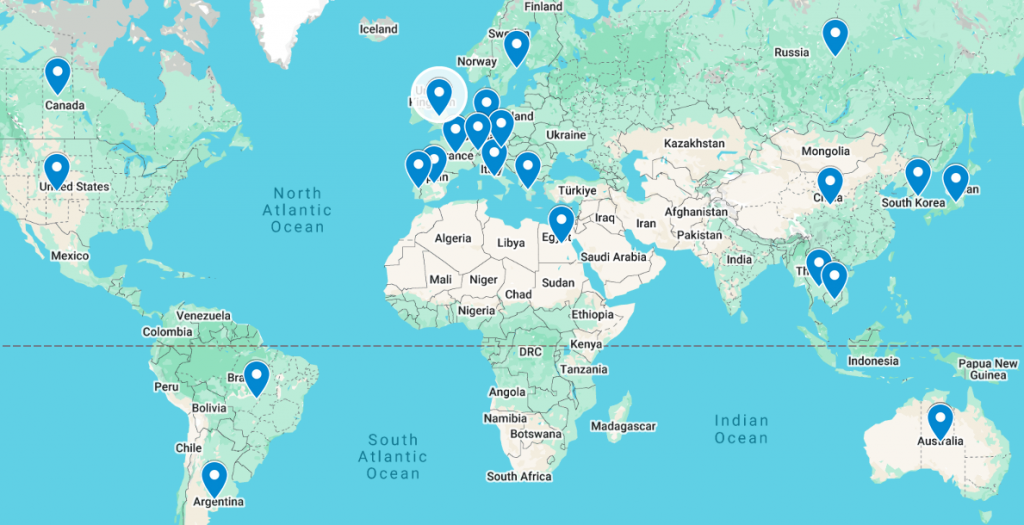
- 70 Erasmus+ KA1 (171) with partner countries such as Italy, Spain, Portugal, Austria, Greece, Poland, and Cyprus.
- 500 outgoing student exchanges, primarily to 19 Italian universities, including Palermo, Messina, Foggia, Calabria, Cassino, Roma La Sapienza, UNINT, Firenze, Pisa, Siena, Tuscia, Bologna, Urbino, Camerino, Modena, Pavia, Trento, Brescia, and Ca’ Foscari – Venezia.
- 120 teaching mobility and staff mobility
- 40 double-degree students trained through international collaborative programs.
- 11 doctoral research fellowships under international training frameworks.